Free SEO Audit Tool: Analyze Your Website in 30 Seconds
Discover 4,500+ hidden SEO issues holding back your rankings. Get a comprehensive technical, on-page, and competitive analysis—instantly.
10,000+ websites audited this month. Average findings: 4,500+ issues per site. Average ranking improvement: 61% within 3 months of implementing fixes.
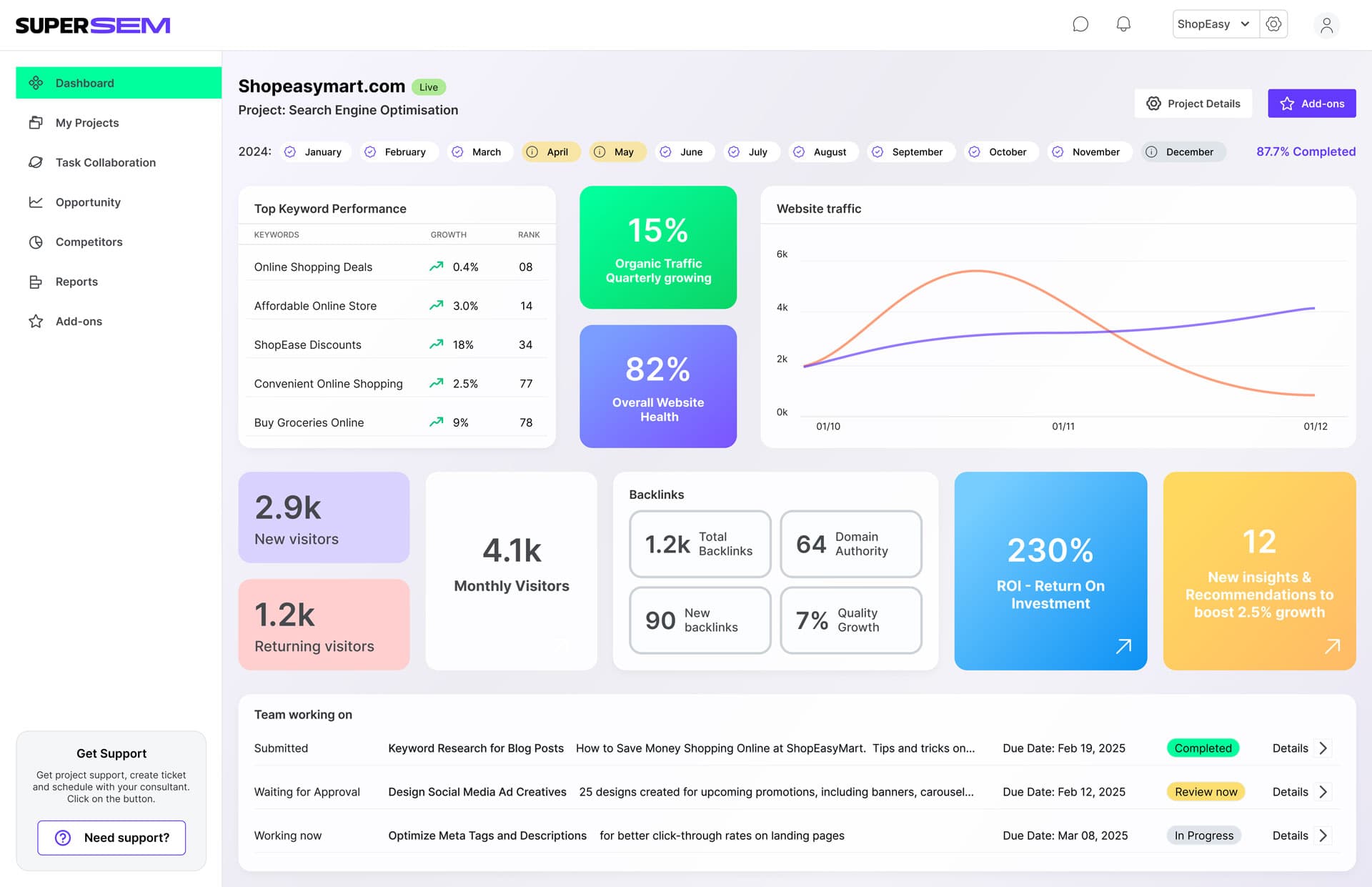
Instant Insights
Comprehensive SEO audits in seconds—know exactly what needs fixing.
Actionable Reports
Get prioritized recommendations with step-by-step fix instructions.
Competitor Comparison
See how you stack up against your top competitors instantly.
Most Websites Have Hidden SEO Problems Slowly Killing Their Rankings
Your website likely has dozens of hidden SEO issues you're completely unaware of. These aren't the obvious problems—broken links or slow loading speeds. These are the subtle technical configurations, metadata gaps, and structural issues that Google's algorithm weighs heavily in ranking decisions.
The harsh reality? 88% of websites fail Google's Core Web Vitals standards. Only 12% of mobile sites pass. And that's just one metric. When you look at the complete picture—technical SEO, on-page optimization, content quality, backlink profile, and schema markup—the average website has 4,500+ SEO issues silently dragging down performance.
Most website owners don't know about these problems until it's too late: organic traffic mysteriously plateaus, then gradually declines. Competitors with smaller budgets start outranking you. Eventually, an algorithm update delivers the knockout punch.
The Real Cost of Ignoring Your Website's SEO Issues
Traffic Declines Gradually
Without regular audits, small issues accumulate. Your site slips down page 1 rankings. Traffic from position 3 to position 4 drops 45%. Position 4 to position 5 drops another 25%. Within 6 months, you've lost 60% of organic traffic and didn't even notice it happening gradually.
Conversion Rates Suffer
Even if you maintain traffic, slow page speed reduces conversions by 7-10% per second of delay. A site taking 4 seconds instead of 1 second can lose 30% of conversions. That's not just lost traffic—it's lost revenue.
You Get Outpaced by Competitors
Your competitors are running quarterly audits. They're fixing issues systematically. While you're stagnant, they're improving methodically. Then when they outrank you, it takes months to recover—if you even catch up at all.
Algorithm Updates Hit Harder
Google releases 12+ core updates yearly, plus countless smaller updates. If your site has underlying SEO issues, each update is a risk. Some sites see 30-50% traffic drops overnight from a single algorithm update because their fundamentals were weak.
Real-World Examples: What Bad SEO Auditing Costs
Case Study #1: E-Commerce Site - $40K/Month Revenue Loss
A mid-sized e-commerce company experienced a sudden 33% traffic drop after migrating their website to a new platform. The migration broke 142 internal links, created redirect chains, and accidentally noindexed the product category pages.
After running a comprehensive SEO audit with Supersem, the issues were obvious:
23 pages with 404 errors
89 pages in redirect chains (causing crawl inefficiency)
156 pages still marked as noindex
Duplicate content on 34 product variations
Core Web Vitals failures on 78% of pages
After fixing these issues over 8 weeks: +18.6% increase in organic sessions (recovered losses), +118% increase in online revenue year-over-year, return to profitability within 12 weeks.
Case Study #2: Travel & Hospitality Company - 278% Traffic Growth
A travel booking company was getting crushed by larger competitors. They ran an SEO audit and discovered:
Missing schema markup (no rich snippets for prices, reviews, availability)
Title tags and meta descriptions on 60% of pages were generic
Internal linking was non-existent (pages were isolated)
Mobile Core Web Vitals failing (LCP >3 seconds)
Content was thin (many pages under 300 words)
They implemented findings systematically: added structured data, rewrote 150+ title tags and meta descriptions, built internal linking strategy, improved page speed (LCP down to 1.8s), and expanded content.
Result: 278% increase in organic traffic over 12 months.
What Is an SEO Audit & Why It Matters for Your Rankings
An SEO audit is a comprehensive analysis of your website that examines 100+ performance metrics and technical factors to identify barriers preventing higher Google rankings.
Think of it like a health checkup for your website. A doctor doesn't just ask, "Do you feel bad?" They run specific tests: blood work, blood pressure, cholesterol levels, etc. An SEO audit does the same—it runs systematic checks across technical infrastructure, content quality, authority signals, and user experience metrics.
The difference between a website that ranks well and one that doesn't isn't usually one big problem. It's 10-20 small problems compounding together. An audit finds all of them.
Why SEO Audits Matter: The Business Impact
SEO audits matter for one simple reason: they turn guesswork into strategy.
Without an audit, you're making improvements in the dark. You might spend $5,000 rebuilding your site structure, but the real problem was actually slow page speed and missing meta descriptions. You fixed the wrong thing.
With an audit, you know exactly where to focus. You identify quick wins—fixes that take hours but deliver massive traffic increases. You avoid wasting money on low-impact optimizations.
The data supports this:
Sites that audit regularly see 61% increase in organic traffic on average
Top performers audit monthly or quarterly (not annually)
Companies that fix their top 20 audit issues see 200%+ traffic growth within 12 months
The average fix takes 4-8 weeks; results take 8-12 weeks to show in rankings
The Four Categories Every Audit Must Cover
1. Technical SEO - Can Google even crawl and index your site?
Your website's technical foundation determines whether Google can access and understand your content. Issues here are catastrophic.
2. On-Page SEO - Are your pages optimized for the keywords people search?
This is where you tell Google and users what each page is about. Title tags, headings, content, meta descriptions—all of this signals relevance.
3. Off-Page SEO - Does your site have authority and trust signals?
Backlinks, citations, and brand mentions tell Google whether other websites trust you. Authority matters for ranking.
4. Advanced Factors - Are you leveraging emerging ranking signals?
Schema markup, Core Web Vitals, E-A-T signals, and user experience metrics increasingly influence rankings.
Miss any of these areas, and you're leaving traffic on the table.
Technical SEO Audit: The Foundation of Crawlability & Indexing
Technical SEO is the boring stuff. It's not about keywords or content. It's about the infrastructure underneath—the plumbing of your website. But it's absolutely critical because if your technical foundation is broken, nothing else matters.
Google can't rank content it can't crawl. It can't index pages it can't access. So technical SEO comes first.
Critical Technical Factors to Audit
1. Site Crawlability & Indexing
Google's crawler works like a visitor. It enters your site, follows links, reads pages, and reports back. If your site has crawl errors, Google stops exploring and never sees your content.
What to check:
Crawl errors: Are there 404 errors (pages that don't exist), 5XX errors (server problems), or timeout errors that block crawling?
Robots.txt issues: Are you accidentally blocking Google from crawling important pages?
XML sitemap quality: Does your sitemap list all important pages? Is it updated regularly?
Canonical tags: Are duplicate pages configured properly so Google knows which version to rank?
Noindex tags: Are any important pages accidentally marked as "don't index"?
Indexation gaps: Google Search Console shows your site has 500 pages, but you have 2,000 pages. Where are the missing 1,500?
Real-world problem:
A SaaS company discovered that 34% of their product pages were marked as noindex due to a template error. They were creating content, driving traffic, but Google was ignoring it. Fixing this one issue recovered $12K/month in organic revenue.
Action items for your audit:
- Log into Google Search Console and check "Coverage" report—note any excluded or error pages
- Run Screaming Frog crawl (free version works) and look for 404s and 5XX errors
- Review robots.txt file—verify you're NOT blocking important pages
- Check your XML sitemap—verify it includes all key pages and was updated recently
- Search site:yourdomain.com in Google—compare results to your actual page count
2. Site Speed & Core Web Vitals
Google made Core Web Vitals an official ranking factor in 2021. This means slow websites are penalized in rankings.
But it's worse than just rankings. Slow sites lose conversions. Every 1-second delay can cost you 7% of conversions. A 4-second page vs. 1-second page loses 30% of potential revenue.
What to check:
Largest Contentful Paint (LCP): How long until the main content is visible? Target: under 2.5 seconds
First Input Delay (FID): How long until the page responds to user interaction? Target: under 100ms
Cumulative Layout Shift (CLS): Does the page layout shift around while loading? Target: under 0.1
Mobile vs. Desktop: Mobile is usually slower. Do you pass Core Web Vitals on mobile?
PageSpeed Insights score: Google's tool gives a 0-100 score for each page
Render-blocking resources: Are there JavaScript or CSS files blocking the page from loading?
Image optimization: Are you serving oversized, uncompressed images?
Real-world problem:
A news site had LCP of 3.8 seconds (failed). After optimizing images and removing render-blocking scripts, LCP dropped to 1.9 seconds. Rankings improved by 15% within 2 weeks, and bounce rate dropped 12%.
3. Mobile-Friendliness & Responsiveness
Google indexes mobile-first. This means your mobile version is what Google actually ranks. If your mobile site is broken, your rankings are broken.
What to check:
Responsive design: Does your site adapt properly to different screen sizes?
Viewport configuration: Is the viewport meta tag set correctly?
Clickable element spacing: Are buttons and links too close together to tap accurately?
Text readability: Is text large enough to read on a 5-inch screen?
Intrusive interstitials: Are you showing pop-ups that block content (Google penalizes this)?
Mobile navigation: Is the menu easy to use on mobile?
4. Security (HTTPS/SSL)
Google prioritizes secure websites. An HTTPS website (indicated by the green lock) ranks better than HTTP.
What to check:
SSL certificate: Is your site using HTTPS? (It should be in 2025)
Certificate validity: Is your certificate expired or invalid?
Mixed content: Are you serving HTTP content on an HTTPS page? (Browsers block this)
Security issues: Does Google Search Console show any security warnings?
On-Page SEO Audit: Content, Keywords & Optimization
On-page SEO is about optimizing individual pages to rank for specific keywords. While technical SEO ensures Google can crawl and index, on-page SEO ensures Google understands what each page is about and how relevant it is to searchers.
Off-Page SEO Audit: Backlinks, Authority & Trust Signals
Off-page SEO is everything external to your site that signals authority and trust. The primary factor is backlinks—votes of confidence from other websites.
Google's algorithm fundamentally works like this: If many high-authority websites link to you, Google assumes you're important and trustworthy.
Real-world problem:
A company had 200 backlinks but 180 came from a private blog network (PBN—artificial link buying). After Google's Penguin update, they lost 60% of rankings. Then they had to spend 6 months disavowing toxic links.
Advanced SEO Factors: Schema Markup, E-A-T & Core Signals
These are the "next-level" optimizations that separate good sites from great ones.
Real-world example:
A product site added product schema to 500 product pages. Within 4 weeks, 30% of search results showed ratings and prices in results, driving 18% higher CTR without ranking change.
Real-world example:
A health blog reorganized its authors section to prominently display credentials (MD, RD, etc.). Visibility improved 25% for health-related searches within 2 months. Readers also trusted the content more.
How to Prioritize & Execute: The 80/20 SEO Strategy
You've identified 100+ issues. You can't fix them all at once. So you need a prioritization framework.
The 80/20 rule applies to SEO: 20% of fixes will drive 80% of your results.
The 4-Level Prioritization Framework
TIER 1: CRITICAL FIXES (DO IMMEDIATELY)
These are blocking issues that prevent any ranking. Time to fix: days to 1 week.
- Crawl errors and indexing issues
- Broken internal links (404s)
- Noindex tags on important pages
- Core Web Vitals failures (LCP > 4s)
- HTTPS implementation gaps
- Mobile responsiveness failures
- Duplicate content at scale
Impact: These fixes can recover 10-30% of organic traffic if they were blocking you.
Action: Fix these within 2 weeks.
TIER 2: HIGH-IMPACT FIXES (DO FIRST MONTH)
These address fundamental optimization gaps. Time to fix: 2-4 weeks.
- Meta title and description optimization
- On-page keyword optimization
- Content quality improvements (expand thin pages)
- Primary keyword targeting clarity
- H1/heading structure fixes
- Internal linking architecture
Impact: These typically drive 30-60% of your SEO improvement.
Action: Plan these to complete in 4 weeks.
TIER 3: MEDIUM-IMPACT FIXES (DO MONTH 2-3)
These add refinement and address secondary opportunities. Time to fix: 4-8 weeks.
- Schema markup implementation
- Secondary keyword optimization
- Backlink acquisition program launch
- Advanced Core Web Vitals optimization
- Content consolidation (remove cannibalization)
- Advanced internal linking
Impact: These typically drive 15-25% additional improvement.
Action: Schedule these for weeks 5-8.
TIER 4: LOW-IMPACT FIXES (DO ONGOING)
These are nice-to-haves that compound over time.
- Minor content tweaks
- Image alt text additions
- Social meta tags
- E-A-T signal improvements
Impact: 5-10% improvement long-term.
Expected Timeline for Results
Week 1-2: Fix critical issues
Google recrawls within days. Minor traffic recovery possible.
Week 3-4: Implement Tier 2 fixes
These take 2-4 weeks to show in rankings. Expect 5-15% traffic increase by end of week 4.
Week 5-8: Implement Tier 3 fixes
Backlinks take 2-4 weeks to pass authority. Schema may show rich snippets within 2-3 weeks.
Month 3-6: Monitor results and iterate
Most sites see 30-100% traffic increase. Top performers see 150-300% increase.
Why Ongoing Audits Matter
The biggest mistake sites make: audit once, fix issues, then ignore it.
Your site isn't static. Content ages. Competitors improve. Google updates algorithms. New issues emerge.
Continuous improvement beats one-time fixes.
Why Choose Supersem.ai for Your Website Audit
You now understand what makes a great SEO audit. But how do you actually get one?
You have options: Manual audit (40+ hours), hire an agency ($2,000-$10,000 per audit), or use a tool. Most audit tools give you a list of issues. That's it. You're left wondering what to do.
Supersem.ai is different.
Here's What Sets Supersem Apart
1. Real-Time Competitor Comparison
See your site directly compared to your top competitors. Instead of just knowing you have 4,500 issues, you see how you rank against competitors. Compare specific metrics: page speed, backlinks, mobile experience, and keyword optimization.
2. Actionable Recommendations, Not Just Issues
Other tools say: "Meta description missing on 47 pages." We say: "Meta description missing on 47 pages. Here's a template to fix it. Here's why it matters. Here's an example of a good meta description." Every issue includes what's wrong, why it matters, exactly how to fix it, expected impact, and tools/resources to help.
3. 30-Second Comprehensive Reports
Get results instantly. No 10-minute crawls. No waiting for reports to generate. Just enter your URL and boom—comprehensive analysis in 30 seconds. Compare to Semrush (5-15 minutes), Moz (3-8 minutes), Ahrefs (5-20 minutes).
4. No Setup Required
No WordPress plugin to install. No account to create. No subdomain to configure. Works on any website. Other tools require installation or configuration. Supersem works on day 1.
5. Beautiful, Client-Ready Reports
Your clients need to understand issues in non-technical language. Supersem reports use simple language, include visual progress scores, color-coded issue severity, visual charts and comparisons, exportable PDF format, and shareable links.
6. Structured Prioritization Roadmap
Don't just get issues—get a roadmap. Supersem shows critical fixes (do this week), high-impact fixes (do this month), medium-impact fixes (do next month), and low-impact fixes (do ongoing). You know exactly what to do, in what order, and why.
7. Embeddable on Your Own Site
Agencies and resellers: Embed the Supersem audit tool on your own website. White-label the tool with your branding, generate leads through the audit (collect emails), and position yourself as the expert.
8. Trusted by 10,000+ Sites
We've audited over 10,000 websites. We see patterns others miss. We know what issues are most common (and highest impact), what fixes drive fastest results, what patterns separate top performers from struggling sites, and what's going to become important before Google officially announces it.
Real Results from Supersem.ai Users
"Doubled our audit-based leads" - Sarah, Digital Agency
"We switched from generic audit tools to Supersem 6 months ago. Our clients are blown away by the report quality. We've doubled our audit-based leads and converted more into ongoing retainers."
"Finally understand what to fix" - Marcus, Freelance SEO
"I love that every issue tells me exactly how to fix it. No more guessing. Clients trust my recommendations because they're backed by data and clear explanations."
"45% organic traffic increase" - Jennifer, E-commerce
"After running the Supersem audit and fixing the top issues over 3 months, our organic traffic increased 45%. The prioritization roadmap saved us from wasting time on low-impact fixes."
"Cut audit time from 40 hours to 10 minutes" - David, In-house SEO
"I used to spend 40+ hours creating custom audits. Now I run Supersem, grab the report, spend time on implementation strategy. Freed up 20+ hours per month."
Frequently Asked Questions About SEO Audits
Find answers to common questions about SEO audits, how they work, and what to expect from your results.
Ready to Audit Your Website & Start Ranking Higher?
You now understand:
The hidden problems most websites have (4,500+ issues on average)
The comprehensive audit process (technical, on-page, off-page, advanced)
How to prioritize fixes (critical first, then high-impact)
The expected results (30-150% traffic growth)
The only thing left is to actually audit your site.
Most website owners know they should audit but keep putting it off. "I'll do it next month." Next month comes, and they still haven't. Meanwhile, competitors are fixing issues and climbing rankings. Every month you delay is another month of lost organic traffic. Lost potential customers. Lost revenue.
The audit takes 30 seconds. The growth takes 3 months. The results last forever.
Start your free audit today.
Your Next Step: Run Your Free Audit
The Supersem.ai SEO audit takes 30 seconds. No credit card. No signup required. No strings attached.
In 30 seconds, you'll know: Your technical SEO score, your on-page optimization score, your authority/backlink score, how you compare to competitors, your top 20 actionable fixes, and a prioritized roadmap to implementation.